- Home
- /
- Lab Rotomoulding Machine
Lab Rotomoulding Machine
A Lab Rotomoulding Machine is a compact and precision-engineered rotational molding system specifically designed for research, product development, material testing, educational institutions, and small-scale production. It enables manufacturers, universities, and R&D laboratories to evaluate new materials, develop prototypes, optimize processing parameters, and conduct quality testing before moving to commercial-scale manufacturing.
Unlike large industrial rotomoulding machines, laboratory rotomoulding machines are designed to process smaller molds while offering precise control over temperature, rotational speed, heating cycles, and cooling processes. This allows researchers and product designers to accurately simulate industrial rotational molding conditions on a laboratory scale.
Lab Rotomoulding Machines are widely used for testing polyethylene materials such as LLDPE, MDPE, HDPE, cross-linked polyethylene (XLPE), recycled polymers, bio-based plastics, and specialty compounds. They are also ideal for developing new product designs, validating mold performance, and training operators in rotational molding technology.
Modern laboratory machines incorporate PLC or touchscreen controls, programmable heating profiles, variable bi-axial rotation, and energy-efficient heating systems to ensure highly repeatable and accurate molding results.
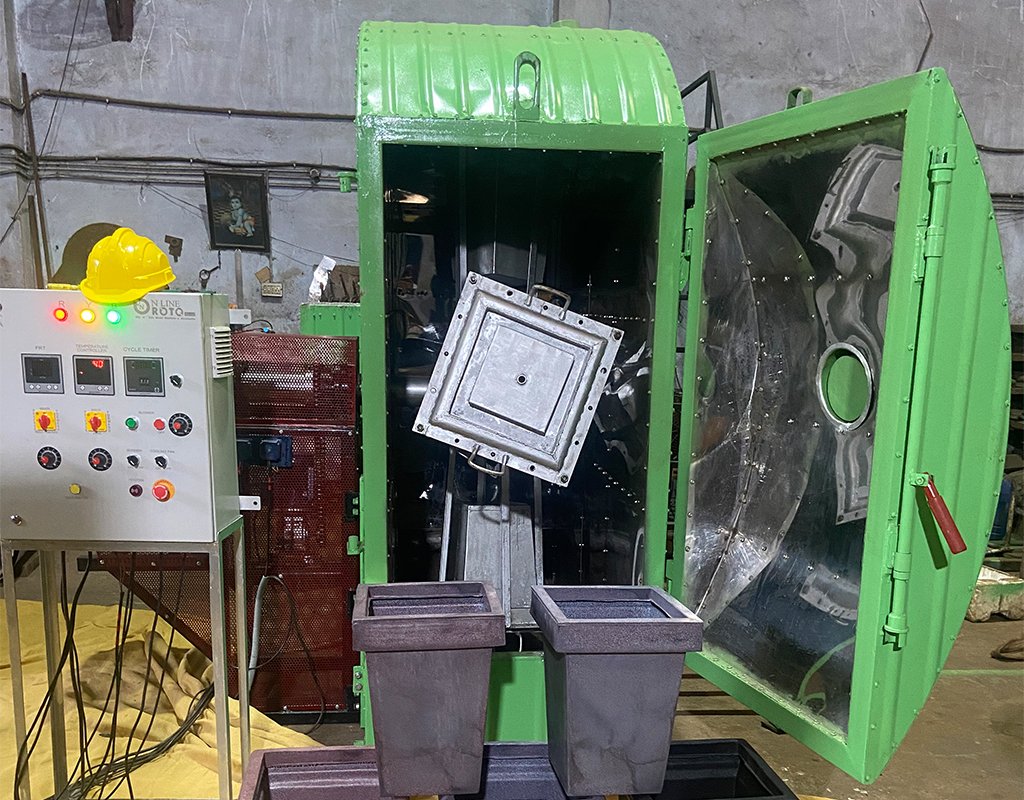
Overview of Lab Rotational Molding Technology
Lab Rotational Molding Technology provides manufacturers and researchers with a controlled environment for developing and evaluating rotationally molded plastic products.
The process closely replicates industrial rotational molding by rotating a mold simultaneously on two perpendicular axes while heating it in a controlled chamber. Plastic powder melts gradually and evenly coats the internal mold surface to create a seamless hollow product.
Because every process parameter—including temperature, rotational speed, heating duration, and cooling cycle—can be accurately controlled, laboratory machines allow detailed evaluation of material behavior and product performance before large-scale production begins.
This technology plays a critical role in reducing development costs, minimizing production risks, and improving product quality.
Key Features
Lab Rotomoulding Machines are equipped with advanced features to support research and development.
- Compact laboratory design
- Bi-axial rotational system
- Precise temperature control
- Variable rotational speed
- PLC or touchscreen operation
- Programmable molding cycles
- Suitable for research and prototype development
- Energy-efficient heating system
- Quick mold change mechanism
- Uniform heat distribution
- Accurate process repeatability
- Air and water cooling options
- User-friendly operation
- Low maintenance requirements
These features enable researchers to achieve highly accurate and repeatable molding results.
Working Principle
The Lab Rotomoulding Machine operates through a sequence of controlled molding stages.
Material Loading
A measured quantity of polymer powder is loaded into a laboratory-scale mold according to the required product dimensions and wall thickness.
Heating Cycle
The mold is placed inside the heating chamber where it rotates simultaneously on the major and minor axes. Controlled heating melts the polymer powder, allowing it to coat the internal mold surface uniformly.
Cooling Process
After the heating cycle, the mold is transferred to the cooling station. Air cooling or water-assisted cooling gradually solidifies the molded product while maintaining rotation.
Product Removal
Once the product has completely cooled, the mold is opened and the finished sample or prototype is removed for testing and evaluation.
Machine Structure and Components
The Lab Rotomoulding Machine consists of several precision-engineered components.
Rotating Arm Assembly
Provides controlled bi-axial rotational movement during heating and cooling.
Laboratory Heating Chamber
A compact insulated chamber ensures uniform heating and precise temperature control.
Cooling System
Air cooling or optional water-assisted cooling solidifies molded samples while maintaining dimensional stability.
Mold Mounting System
Quick-change mounting fixtures allow easy installation of different laboratory molds.
Drive System
Precision motors and gearboxes provide accurate control of rotational speeds on both axes.
PLC / Touchscreen Control Panel
The control system manages temperature profiles, rotational speed, heating time, cooling cycles, and data recording.
Industrial Applications

Research & Development

Educational Institutions

Plastic Manufacturing

Industrial

Material Testing
Advantages of Lab Rotomoulding Machine
Ideal for Research and Development
Perfect for evaluating new materials and product designs before commercial production.
Precise Process Control
Offers accurate control of temperature, rotation speed, and cycle parameters.
Cost-Effective Development
Reduces development costs by validating designs before large-scale manufacturing.
Excellent Repeatability
Provides consistent and repeatable molding conditions for research applications.
Compact Design
Occupies minimal laboratory space while delivering industrial-grade performance.
Flexible Testing
Supports multiple mold sizes and a wide range of polymer materials.
Limitations of Lab Rotomoulding Machine
Despite its many advantages, certain limitations should be considered.
Limited Production Capacity
Designed primarily for research and prototype development rather than mass production.
Smaller Mold Sizes
Cannot accommodate very large industrial molds.
Higher Cost Per Sample
Prototype production costs are generally higher than full-scale manufacturing.
Research-Focused Operation
Best suited for laboratory environments rather than continuous industrial production.
Why Choose N Line Roto Pvt. Ltd.
N Line Roto Pvt. Ltd., formerly known as Neelam Roto Plast, has been manufacturing advanced rotational molding machinery since 1993.
The company offers high-quality laboratory rotomoulding machines designed for research institutions, universities, polymer laboratories, and industrial R&D centers.
Key Strengths
- Advanced manufacturing facility
- Experienced engineering professionals
- Customized laboratory machine solutions
- Precision-engineered equipment
- Energy-efficient designs
- Technical consultation and application support
- Reliable after-sales service
- Global export capabilities
Under the leadership of Mr. Dinesh Panchal, N Line Roto Pvt. Ltd. continues to deliver innovative rotational molding solutions that support research, education, and industrial product development.
Frequently Asked Questions (FAQs)
A Lab Rotomoulding Machine is a compact rotational molding system used for research, material testing, product development, and prototype manufacturing.
It is used to develop new products, evaluate polymer materials, optimize molding processes, and produce prototype components.
Plastic manufacturing, polymer research, universities, technical institutes, and industrial R&D laboratories.
LLDPE, MDPE, HDPE, XLPE, recycled polymers, and specialty plastic compounds.
Yes, it rotates molds simultaneously on two axes for uniform material distribution.
Electric and gas heating systems are commonly available.
No, it is primarily intended for laboratory testing and prototype development.
Yes, the machine supports interchangeable laboratory molds.
Air cooling and optional water-assisted cooling systems.
Yes, manual, semi-automatic, and fully automatic versions are available.
Yes, PLC and touchscreen controls allow precise adjustment of all molding parameters.
Yes, it is ideal for evaluating new polymer formulations and additives.
Yes, it is widely used in engineering colleges, universities, and polymer training centers.
Yes, like industrial rotational molding machines, it produces seamless hollow components.
Yes, advanced control systems can store and monitor production parameters.
The quantity of polymer powder loaded into the mold determines wall thickness.
No, the machine features a simple design with low maintenance requirements.
Yes, machine size, control systems, and heating methods can be customized.
It enables cost-effective product development, material testing, and process optimization before commercial production.
Because of their expertise in rotational molding technology, precision engineering, customized solutions, and dependable technical support.
Related Products
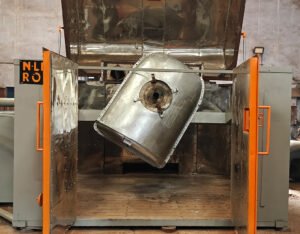
Clamshell Rotomoulding Machine
A Clamshell Rotomoulding Machine is a highly efficient rotational molding system designed for manufacturing hollow plastic products of various shapes and sizes.
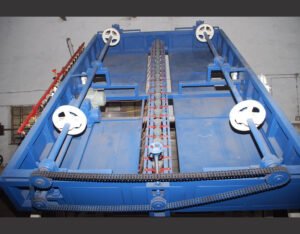
Rock N Roll Rotomoulding Machine
Home / Rock N Roll Rotomoulding Machine Rock N Roll Rotomoulding Machine A Rock N Roll Rotomoulding Machine is a…
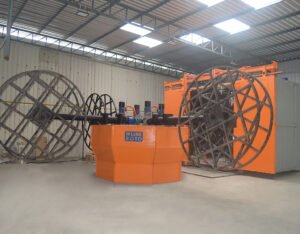
Bi Axial Rotomoulding Machine
A Bi-Axial Rotomoulding Machine is an advanced industrial machine designed to manufacture hollow plastic products through a rotational molding process where the mold rotates simultaneously on two perpendicular axes.